
Around the Moon and Back: Inside the Artemis II Mission
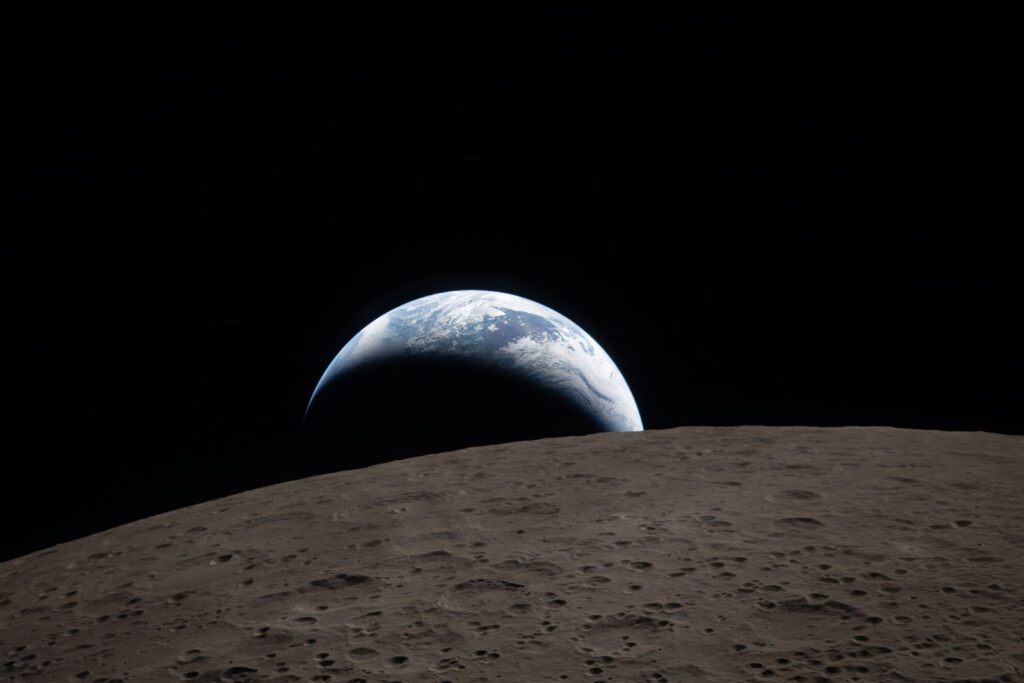
Artemis II marks a historic milestone in modern space exploration as the first crewed mission of NASA’s Artemis program, designed to return humans to the Moon after more than 50 years.
The mission sent four astronauts on a roughly 10-day journey around the Moon and back to Earth, testing critical systems for future lunar landings. Unlike its predecessor, Artemis I, which was uncrewed, Artemis II carried humans beyond low Earth orbit, pushing the boundaries of human spaceflight once again.
The insides of the Artemis II travel
The mission used NASA’s powerful Space Launch System (SLS) rocket and the Orion spacecraft, which is specifically designed for deep-space travel. During the flight, astronauts tested life support systems, navigation, and communication technologies essential for long-duration missions.
Artemis II also followed a “free-return trajectory,” meaning the spacecraft looped around the Moon and naturally returned toward Earth.
Discoveries from deep space
Visually, Artemis II was a very technological spectacle and a symbolic moment. It is said that from the launch, the towering SLS rocket represented the most powerful launch system ever built, renew imagery reminiscent of the Apollo era. In space, astronauts captured unique views of the Moon’s far side, Earth from deep space, and even a total solar eclipse, offering perspectives rarely witnessed by humans.

Journey back home
The return to Earth was the most difficult, technically demanding and dangerous phase of the mission. The Orion capsule re-entered Earth’s atmosphere at speeds approaching 25,000 miles per hour, generating extreme heat. Temperatures during re-entry reached thousands of degrees Celsius, requiring advanced heat shield technology to protect the crew.
During descent, Orion followed a carefully calculated trajectory to ensure both safety and landing precision. Engineers initially considered a “skip reentry” method to reduce heat exposure, but ultimately opted for a stronger, direct entry profile. This approach minimized risk after previous concerns observed during Artemis I heat cover performance.
As it slowed down, parachutes opened to help it land safely on the water. The capsule ultimately landed in the Pacific Ocean off the coast of San Diego, where recovery teams, including the U.S. Navy, were waiting. The landing marked the successful completion of a journey of over one million kilometers, demonstrating that Orion can safely return humans from deep space.
Successful return from the deep space
The splashdown itself was described as a “bullseye” highlighting the precision of the mission’s planning and execution. After landing, astronauts were retrieved and underwent medical evaluations before returning to NASA’s Johnson Space Center. Their safe recovery confirmed the reliability of systems that will be essential for future missions, including Artemis III, which aims to land astronauts on the Moon.
In conclusion, Artemis II was not just a mission but a rehearsal for humanity’s return to deep space exploration. Its successful journey and return to Earth validated technologies, operational procedures, and human endurance required for future lunar and even Martian missions. As global interest in space exploration grows, Artemis II stands as a defining step toward a new era often described as a “golden age of space travel.”
