
Academic Journeys: Navigating the Final Stretch in Poland vs. Spain

Navigating the final years of university can feel like a marathon, yet the finish line looks remarkably different depending on whether you are in Warsaw or Madrid. From the structural rhythm of the academic year to the weight of the final thesis, Poland and Spain offer two distinct philosophies on how to turn a student into a professional.
Differences in academic calendar
The first most visible – from the student’s perspective – difference is the academic year timeline. In Poland the university time starts in October and and last until June. This gives Polish students a long, golden summer, though the «winter session» in February provides a sharp reality check.
In Spain, on the other hand, the «curso académico» begins in September and often concludes in May. While the Spanish calendar might seem to cut summer short, it allows students to finish their exams before the blistering heat of the summer truly takes hold, whereas Polish students are often still studying textbooks in mid-June.
Structure of the university process
However, the real divergence lies in the duration of the degree cycles. Following the Bologna Process, Poland generally adheres to a 3+2 model: three years for a Bachelor’s and two for a Master’s. Spain, conversely, opts for a 4+1 (or 4+2) structure. In Spain, the Grado (Bachelor’s) is a more extensive four-year commitment, while Master’s programs are often condensed into a single intensive year. This reflects a Spanish preference for a broader foundational education before specialization.
Integrated Practice vs. Formal Separation
The way students learn throughout the semester dictates how they are assessed during finals. In Poland, there is a rigid, traditional distinction between lectures and tutorials or labs. These are often treated as separate entities; you might pass the practical component but fail the theoretical exam, or vice versa.
In Spain, the trend is moving toward integrated learning. While lectures exist, the boundary between theory and practice is blurred. Assessments often combine continuous evaluation evaluación continua with final exams, meaning your daily performance in «practical-theoretical» workshops carries as much weight as the final test. While Polish students often face a «make or break» exam session at the end of the term, Spanish students are often under a constant, albeit more distributed, pressure throughout the semester.
The thesis and defending process
Here is where the two systems diverge most sharply. In Poland, the Bachelor’s Thesis is a mandatory rite of passage. Even at the three-year mark, students must produce an original piece of academic writing and undergo a formal «defense» in front of a committee. It is a stressful, formal affair involving suits, ties, and bouquets of flowers for the professors.
In Spain, the focus is shifted. While there is a final project (Trabajo de Fin de Grado), it often feels less like the traditional, heavy academic «thesis» seen in the Polish. The real academic heavy lifting is reserved for the Master’s Thesis (Trabajo de Fin de Máster). For many Spanish students, the end of the Bachelor’s is more about completing credits than defending a massive volume of research.
The Grand Finale
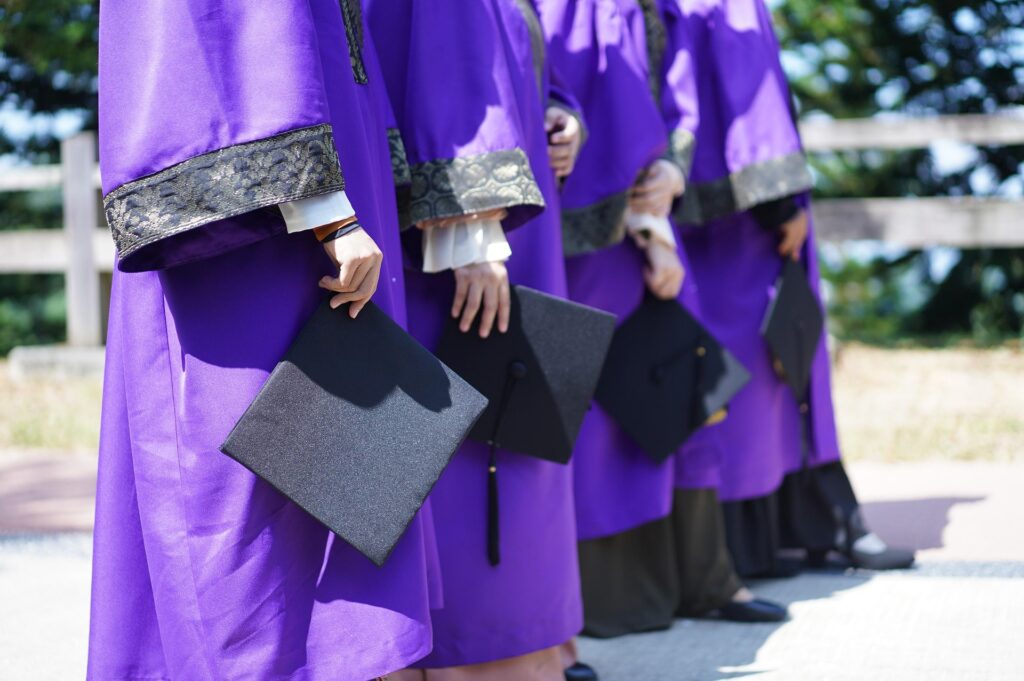
When the dust settles, how do they celebrate? In Poland, graduation is often marked by the Absolutorium. It’s a dignified ceremony where students wear caps and gowns, and the choir sings Gaudeamus Igitur. However, the «real» party is often a faculty-wide gala or a series of informal «poprawiny» (after-parties) in local clubs.
Spain takes the celebration to another level. A Spanish Graduación is a massive family event. The standout feature is the «beca» – a colored sash representing the faculty (yellow for medicine, blue for humanities, etc.). After the formal speeches, the «fiesta de graduación» begins, often involving massive dinners with family followed by a night of dancing that lasts until sunrise.
Ultimately, the Polish system leans toward a more structured, academic rigor with its early emphasis on thesis writing and separate practical credits. Spain, meanwhile, offers a more integrated, holistic approach that culminates in a vibrant, community-focused celebration. Whether you are defending a thesis in Kraków or receiving your sash in Salamanca, the relief of that final «pass» remains a universal language.
Is there a specific part of the academic journey, like the stress of the «obrona» or the Spanish «fiesta» culture, that you’d like to dive deeper into?
