
AI in Journalism: Is Artificial Intelligence Changing the Way News Is Produced?

Artificial intelligence is no longer a futuristic idea in journalism. It has already entered the newsroom and is reshaping how stories are gathered, written, edited and distributed. From transcription tools and automated tagging to trend detection and personalised recommendations, AI is changing the rhythm of journalistic work. But the more visible this transformation becomes, the more urgent the central question is: can journalism embrace speed and automation without losing accuracy, trust and human responsibility?
AI is becoming part of everyday newsroom work
Artificial intelligence is increasingly used in journalism not to fully replace reporters, but to support them in everyday work. In the attached study, AI is described as a tool that helps automate newsroom processes, especially in gathering material, producing content and distributing it to audiences. This includes transcription, speech-to-text conversion, tagging, summaries, headline creation and content recommendation. All three areas are deeply interconnected. Respondents highlighted both the benefits and the limitations of these tools. On the positive side, one noted:
«Transcription services like Otter are invaluable for reporters working under time pressure, and our tagging tool streamlines production processes for publishers»
However, not all experiences were positive. Another respondent expressed frustration with speech-to-text technology:
«I tried using an automated transcription service like Otter.ai to transcribe my interviews, but it was very inaccurate. The programme had difficulty transcribing interviews where people spoke with an accent»
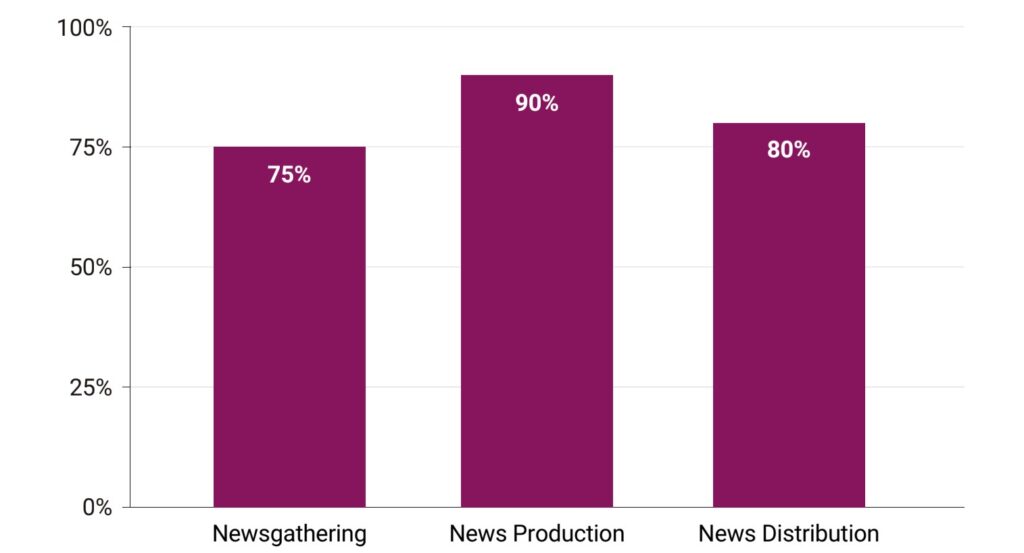
The scale of this shift is already visible. According to the Generating Change report, cited in your thesis, more than 75% of surveyed news organisations use AI in at least one part of the news production chain, while 90% use it in production, 80% in distribution and 75% in newsgathering. These figures show that AI is no longer an experiment in journalism. It is becoming part of normal newsroom practice.
For many editors, the main advantage is simple, it is time. AI helps reduce routine work so journalists can focus more on analysis, interpretation and creative tasks. In this sense, artificial intelligence is changing not only how fast news is produced, but also how newsroom labour is organised.
Faster production vs editorial quality
Efficiency does not always equal quality. The study distinguishes between automated journalism and augmented journalism, where AI supports but does not replace human control. The main risk here is bias and inaccuracy, as algorithms can reproduce social prejudices.
This explains why newsrooms are cautious. According to the Generating Change report, 82% of respondents are concerned about editorial quality and the overall impact of AI on the media industry. Furthermore, over 60% expressed specific ethical concerns regarding how AI might affect journalistic standards

The challenge of disinformation and trust
AI also makes disinformation harder to control. Recommendation systems and viral algorithms have become primary channels for spreading false content. The scale is clear: according to the Digital Poland report, 84% of people have encountered fake news, and 81% believe disinformation has increased over the last decade. Audiences are demanding transparency. 86% of respondents believe that any content created with AI should be clearly labelled. This is why the Paris Charter on AI and Journalism insists that editorial responsibility must remain a human task.

A new role for the journalist
The journalist’s role is evolving from a simple transmitter to a verifier and curator. While AI can generate posts or graphics, it can not replace investigative reporting or the watchdog function of the press. In an era of algorithmic selection, the human ability to provide context and ethical judgment is becoming more valuable than ever.
This shift means that the modern reporter must become an AI-literate professional. Instead of competing with speed, journalists are focusing on high value tasks that require critical thinking and deep investigation areas where algorithms still fail. As the industry adapts, the goal is not to work against technology, but to use it as a shield against disinformation while preserving the human heart of storytelling.


AI & humans
AI is already reshaping newsrooms by automating gathering, production, and distribution. However, its success depends on maintaining the values of accuracy and transparency. Technology can produce the news, but only humans can remain responsible for the truth.
